What counts as a noise night
We took the night as the eight hours from 11pm to 7am, the night period used in the EU noise directive. A night counts if any one of those hours had 0.5 mm of rain or more, the point where the Met Office intensity bands move from slight to moderate. Light drizzle alone does not count.
The hourly figures come from the Met Office UKV 2 km model, through Open-Meteo, for 2024 and 2025: 1,754,400 readings across 100 towns. How we cleaned and counted them is set out on the method page.
- 65
- noise nights a year in the average town
- 6
- downpour nights, with an hour over 4 mm
- 72
- noise nights in 2024, against 58 in 2025
The towns with the most wet nights
Towns facing the Atlantic weather, and those up against high ground, take the brunt. Kendal topped the count at 92 noise nights a year, and the wettest town overall was Kendal at 1,787 mm. Places sheltered on the drier eastern side sit far lower, with Northallerton at the bottom on 48.
A spread that wide means a roof in one town gets far more chances to break your sleep than the same roof in another. The whole table, with a CSV to download, is on the Noise Nights league page.
- 92 nights
- 92 nights
- 89 nights
- 89 nights
- 87 nights
- 87 nights
- 86 nights
- 86 nights
Set against a bedroom guideline
The World Health Organization advises that a bedroom should average no more than 30 dB across the night, with single noise events kept below 45 dB. Those are figures for the sound level inside a room, so they do not line up neatly with roof test results.
Still, the scale is telling. Corrected for natural moderate rain, the lab level for 25 mm polycarbonate comes out at about 45.7 dB, and for roof glass about 33.1 dB. One sits around the WHO ceiling for a single event, the other nearer the night average. A lab measure, not a reading from your pillow, but it shows why a plastic roof over a sleeping room causes complaints and glass less so. The sound explainer walks through the sources.
When in the year the nights are wettest
No month in our data is free of them, but they are not spread evenly either. The run from September to November carries the most, as Atlantic fronts start to arrive one after another and drag rain on through the small hours, and the winter months are not far behind. June and August were the quietest months across our towns. The chart shows the average town month by month.
- 6.4Jan
- 6.9Feb
- 5.3Mar
- 5Apr
- 4.7May
- 3.8Jun
- 4.8Jul
- 2.9Aug
- 6.7Sep
- 6.2Oct
- 7.3Nov
- 5Dec
noise nights, the three highest picked out. Average of 100 towns, 2024 and 2025. Source: our rain ledger.
Living with it, or changing the roof
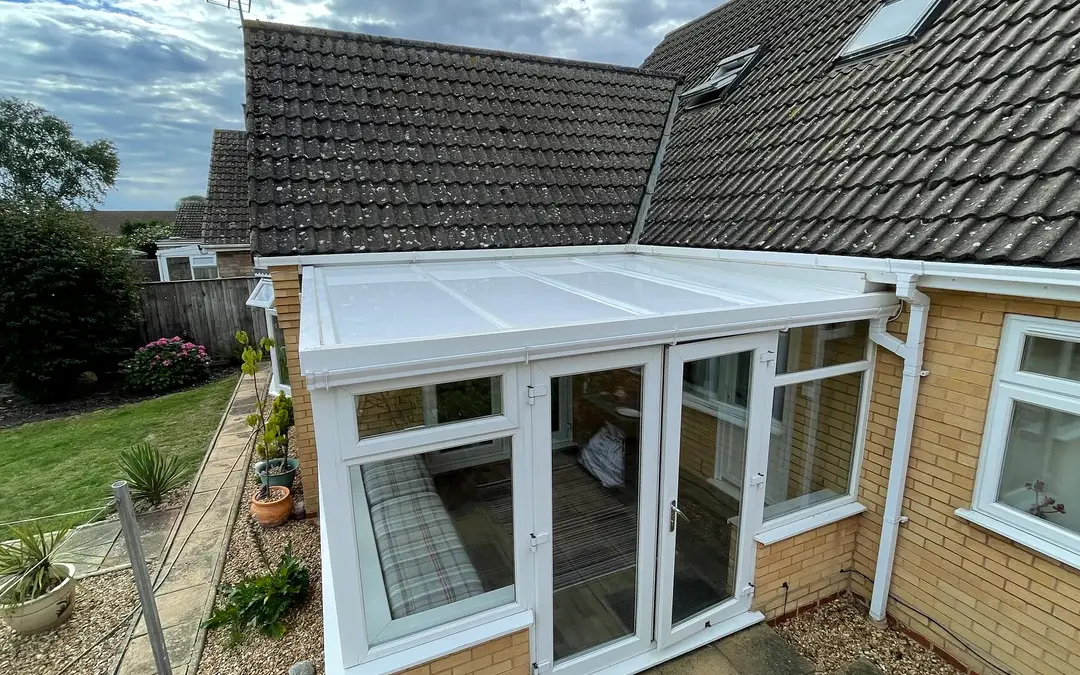
Some steps cost nothing. On a wet forecast, close the inner door from the garden room to the hall, so the patter is not carried up the stairs. Keep a bed or a cot out of there through the winter months. Check that the glazing bar caps are tight, because a rattling cap is often the loudest thing on the roof at 3am.
If the room needs to work at night, the roof is the thing to change. We fit 75 mm insulated panel roofs with a solid ceiling and no hollow sheets. Nobody has published a rain noise test for this kind of conservatory panel and we have not measured ours, so we do not promise a number. You can see your own town on the Rain Ledger and ask us for a fixed price after a free survey.