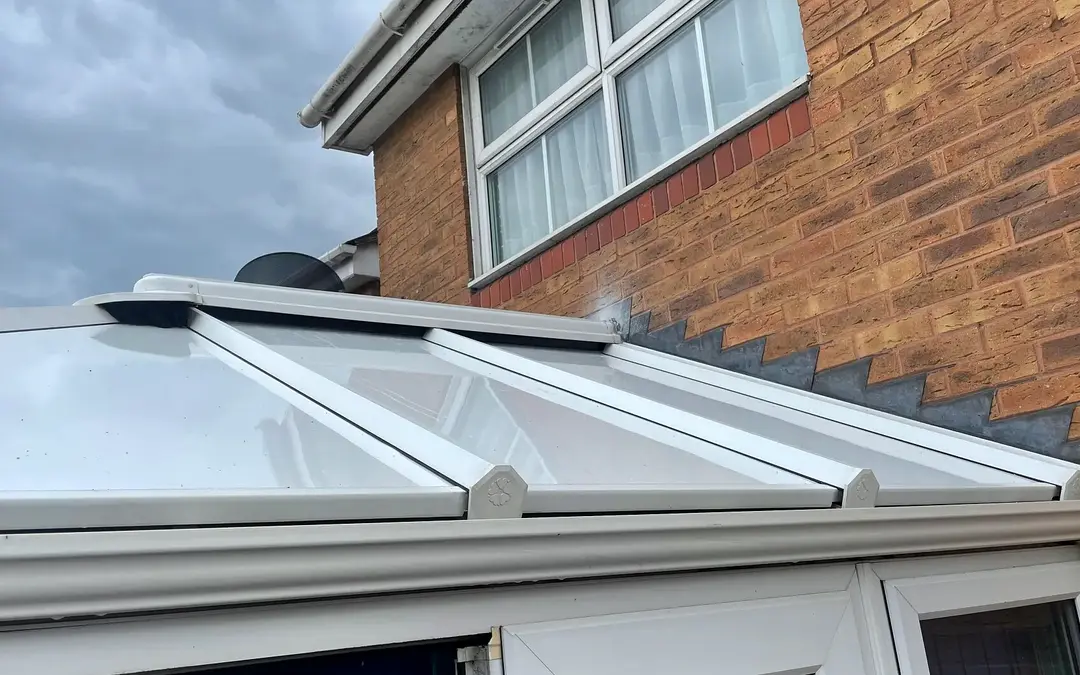
Polycarbonate in 16, 25 and 35 mm
A great many older British conservatories went up with polycarbonate: a clear plastic sheet made of two or more thin walls held apart by ribs, with hollow channels called flutes running down the slope. The older and cheaper builds used 16 mm sheet, which loses about 2.3 to 2.8 W/m²K. 25 mm sheet followed, at about 1.6 to 2.4, and 35 mm sheet adds more walls and does a little better again, though it is still hollow plastic.
Those flutes are also why the sheet is loud. In a lab heavy rain test the BRE measured 25 mm polycarbonate at 64.6 dB, with most of the sound in the sharp upper range above 1.6 kHz. Our page on why a polycarbonate roof drums in the rain goes through the physics.
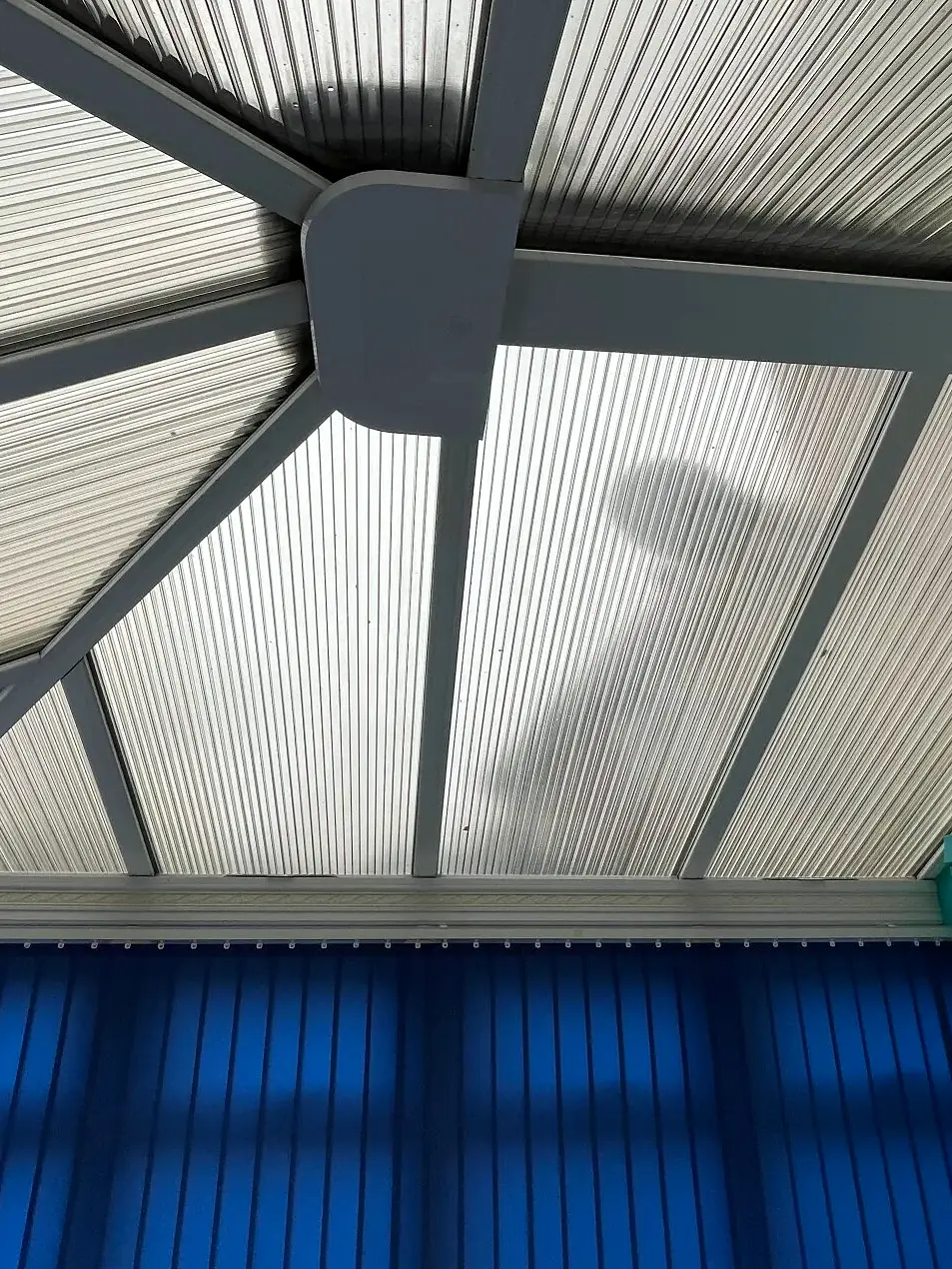
Glass roofs, old units and new
A glass roof is a set of sealed double glazed units sitting in the glazing bars, the same idea as a window turned on its back. Older roof units lose about 2.8 W/m²K. Modern low-e roof glass carries a thin metal oxide coating that bounces heat back into the room, and comes in at about 1.2 to 1.6.
Glass is quieter than plastic under rain: the same BRE test put double glazed laminated roof glass at 52.0 dB, a gap of 12.6 dB. It is also heavy, it lets the sun straight in on a July afternoon, and it puts every fallen leaf on show from the sofa. Our panel roof or new glass roof comparison sets out where each wins.
Insulated panel roofs
This is the only type we fit. Each panel is a 75 mm board of rigid foam bonded between two aluminium skins, painted on the outside and smooth white on the ceiling side. The panels sit on your existing glazing bars once the frame has been checked, so the conservatory below keeps its walls, windows and doors.
At about 0.43 W/m²K a panel roof holds heat far better than any glass or plastic roof. On rain noise we are straight with you: nobody has published a rain test for conservatory panels of this build, and we have not measured ours, so we give no decibel figure. What we can say is that there are no hollow flutes and the foam is glued solid to both skins. Our page asking whether insulated panels are any good weighs the rest.
| Built from | U-value | |
|---|---|---|
| Polycarbonate 16 mm | Twin wall plastic sheet with hollow flutes | about 2.3 to 2.8 |
| Polycarbonate 25 mm | Multiwall plastic sheet | about 1.6 to 2.4 |
| Polycarbonate 35 mm | Thicker multiwall sheet | a little under 25 mm sheet |
| Glass, older units | Sealed double glazed roof units | about 2.8 |
| Glass, modern low-e | Double glazed units with a heat reflecting coat | about 1.2 to 1.6 |
| Insulated panels | 75 mm foam core between aluminium skins | about 0.43 |
| Hybrid | Panels with one or more glazed sections | between the two, by area of glass |
Heavier solid roofs built on site
The heaviest option is a roof built up layer by layer like the roof of a house: timber rafters, insulation between them, a plastered ceiling underneath and a weatherproof covering on top. It is a building job lasting days rather than a roof swap, and the weight usually means the frame below has to be strengthened or rebuilt before it can carry it.
We do not build these. If you are comparing loads, our page on how much an insulated roof panel weighs explains why panels can sit on a frame that was designed for glass or plastic.
Hybrid roofs: panels with some glass
A hybrid keeps most of the roof as insulated panel and puts glass back in one or two places, usually a roof light above a seating area or a glazed strip along the ridge. You trade a little warmth for a patch of sky.
Any glass you add behaves like glass. A glazed roof window measured 52.5 dB under lab heavy rain in a 2026 study, close to the BRE figure for roof glass. Our hybrid roof guide covers how much glass is sensible.
All panel
- Lowest heat loss of the types here
- Even, shaded light from the glass walls
- One smooth ceiling, ready for spotlights
Panel with glass sections
- Daylight from overhead where you want it
- More heat loss over the glazed area
- Rain on the glass sounds like glass